





We finance caskets CLICK HERE and send it directly to the funeral home of your choice.
Or go directly to the application HERE.

We finance caskets CLICK HERE and send it directly to the funeral home of your choice. Or go directly to the application HERE.
I’ve talked about the book, Megatrends, by John Naisbitt before. It was published in 1982 and sold 14 million copies and after reading it about the time it was written, its “Social Forecasting”, and my belief in that concept, played a major role in building my funeral business and other businesses I was involved in.
I became a huge believer in Naisbitt’s trends and bought hook, line, and sinker that I should incorporate them into how I made decisions to move my business forward. For instance, one of those trends was moving from “Centralized” leadership to “Decentralized” leadership or another was moving from “Hierarchies” (a pyramid structure with few at the top) to “Networking” (every employee gets a say).
We finance caskets CLICK HERE and send it directly to the funeral home of your choice. Or go directly to the application HERE.
Here is a summary of Naisbitt’s “Megatrends” that will move society. Remember, these were written in 1982.
This might sound strange today, but in 1982 centralizing the leadership and then giving commands to employees was the way business was done. . . .and generally the owners of companies joined the business clubs like Kiwanis and Rotary with the business paying their dues and membership fees and the employees generally were not involved in those business clubs.
We finance caskets CLICK HERE and send it directly to the funeral home of your choice. Or go directly to the application HERE.
Reading Megatrends gave me two initiatives that greatly brought my business positive momentum. . . First of all, I changed from a “Centralized and Hierarchal” system of making arrangements whereby the owner made the arrangements and was on the front line with the families and then ordered employee funeral directors on how to handle the funeral to a “Decentralized and Networking” process whereby all funeral directors made arrangements and dealt with families. . . Each funeral director made their own decisions, without having to ask the owner, on how the funeral service would go.
 Secondly, I made available a pool of money for all employees, not just the owner, to join business or social clubs at the company’s expense within the dicatates of Internal Revenue rules. And, followed up by giving employees time off from the facility to attend the functions that their club(s) was/(were) busy with.
Those decisions sound like a simple smart business modus operandi today, but it was not how things happened in the early 1980’s. Especially, in small family operated businesses. . . It was generally the owner out front taking credit and the funeral director employees in the back room doing the work. It’s just the way it was. . . . When I think of that time I cannot help but think of the cartoon classic “The Jetson’s” and the relationship between Mr. Spacely, owner of “Spacely Sprockets” and his employee George Jetson. . . or of the relationship on the 1960’s “sitcom” Bewitched between the boss Mr. Larry Tate and his employee Darin Stevens.
That gets me to another of Naisbitt’s Megatrends that is still taking place today. He had the incredible insight to realize that our society would move at some point in time to an “Information Society” – after our country had passed through an agriculture society, an industrial society, and a technolgical society. Here’s what Naisbitt said back in 1982 about “Information”:
“Information is an economic entity because it costs something to
produce, and because someone is willing to pay for it. Value is
whatever people are willing to pay. If an economy built around
information seems less real than one built around steel &
automobiles, it doesn’t matter so long as people are willing to pay
for information.
In the 1930s, society became organized around the automobile.
All that the automobile contributed was transportation. Today’s
society is becoming organized around the computer, which has
an orientation to expand your brain power through growth,
education and learning. The computer age will deal with
conceptual space, connected by electrons as opposed to
physical space connected by the motorcar.”
In my opinion we are continuing to live in that “Information” society today. . . .and relying on it to a greater and greater extend each day. As we continue to move forward consumers are showing a greater reliance each day on “Information” when they make their consumer purchases.
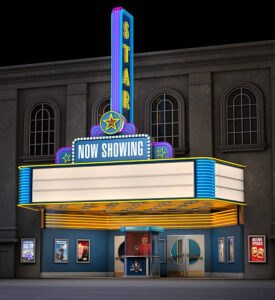
For instance, my wife and I spend three months each winter in South Florida. We still don’t know the area that well, but when we want to do something like go to a movie theatre, we get all the “information” that we can get through “conceptual space” on our computer or mobile phone without moving through “physical” space. Here’s what we do:
- Look on a map to see where theatres are located in relation to where we are at.
- Once we locate theatres we look to see what movies are playing there.
- Once we find the movie that we like, we look for specific times that fit our schedule.
- Once we are satisfied, we look for seats, pricing, and then purchase our ticket.
Now, we are ready to go. However, think if the movie theatre you owned didn’t have a website or did not put the movies and times that they were offered on that website your theatre, regardless how wonderful it is, would not be chosen. I can guarantee you that we would have skipped right over your theatre because we are no longer comfortable or see value in going through the efforts to call or drive by your theatre when we can make other choices from the comfort of our home chair.

Tom Anderson
Funeral Director Daily
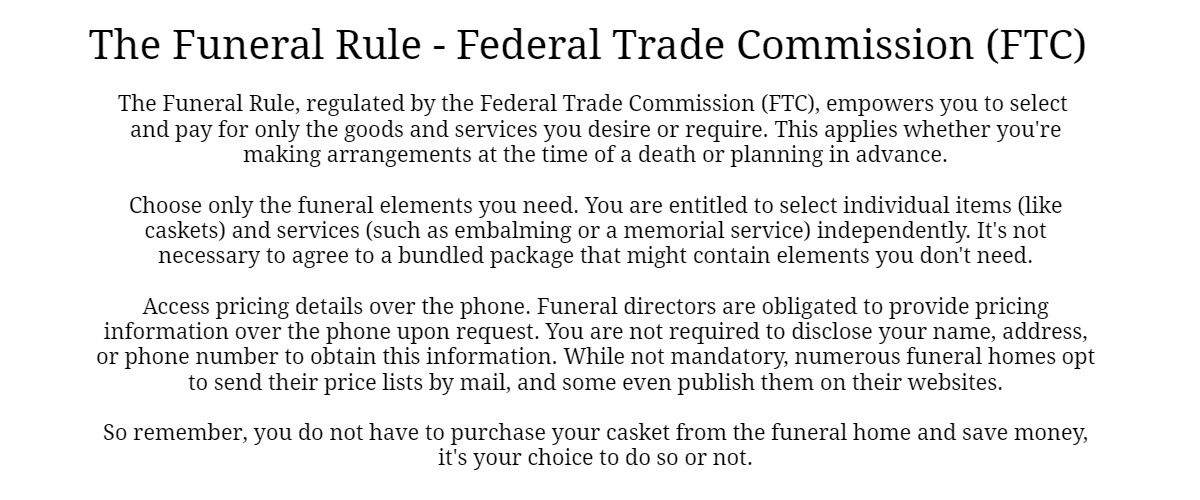
It’s my opinion that that is exactly what is happening and will continue to happen at a higher occurence rate to death care providers that do not offer enough “information” on their website. . . and that includes pricing. While I don’t agree that the federal government should mandate website pricing as a consumer protection, I do believe it is in a funeral home’s best interest to put pricing on their website on a voluntary basis.
I’ve gotten stronger with my belief on this subject and every time I write something like this I will get a couple of emails from funeral directors who tell me they like having potential clients call them so they can explain what they do, how it benefits the client family, and how they charge for it. They tell me that “many times the consumer will tell me that even though those prices are a little higher than what I saw online, I like the personal touch and will be coming to your funeral home because of that.”
I don’t doubt that that happens because it happened at my funeral home exactly the same way. . . . What I’m concerned about today as we get more and more into the “Information” society is that for every call you get like that, you probably have a dozen potential clients who, like me with my movie example, have passed you by because they did not see the “information” that they wanted on your website and were not willing to call or drive over because it was so simple to find their answers on competitor’s websites.
Here’s an article from Forbes that I found while doing this article entitled, “What John Naisbitt taught me about the Future“. I found it interesting and also found this Naisbitt quote in it which I think explains why you should look at consumer trends, like online pricing, for your funeral home business modus operandi:
“Trends, like horses, are easier to ride in the direction they are going.”
More news from the world of Death Care:
Enter your e-mail below to join the 3,484 others who receive Funeral Director Daily articles daily:
“A servant’s attitude guided by Christ leads to a significant life”

Source link
Click the APPLY NOW BUTTON below to find out more about financing a casket.



Affordable Caskets and Urns for Sale We Finance Bad Credit No Credit OK
Spanish: Ataúdes y Urnas Económicos en Venta - Financiamos Aunque Tenga Mal Crédito o Sin Crédito
French: Cercueils et Urnes Abordables à Vendre - Nous Finançons, Mauvais Crédit ou Pas de Crédit Accepté
Japanese: 手頃な価格の棺および壺を販売 - 悪いクレジットやクレジットがなくてもファイナンス可能
Korean: 저렴한 관과 운구 판매 - 나쁜 신용 또는 신용 없음, 금융 지원 가능


